
READING BETWEEN THE LINES: A POSITIVE BUDGET, BUT ONE THAT DEMANDS CAUTION
The 2026 National Budget positions itself as a turning point, and National Treasury certainly wants South Africans to feel that way. In its official presentation, Treasury frames the Budget as “a fiscal turning point in a resilient economy”, highlighting stabilising debt, improving revenue performance, and the return of policy credibility.
There is real substance behind this optimism, as we explore in this month’s Financial View. But as we unpack what it means for households, investors and businesses, we must keep a clear eye on both the encouraging progress, and the structural risks still lurking below the surface.
Treasury’s Optimism: What’s Driving the Positive Tone?
- Years of fiscal discipline are starting to pay off
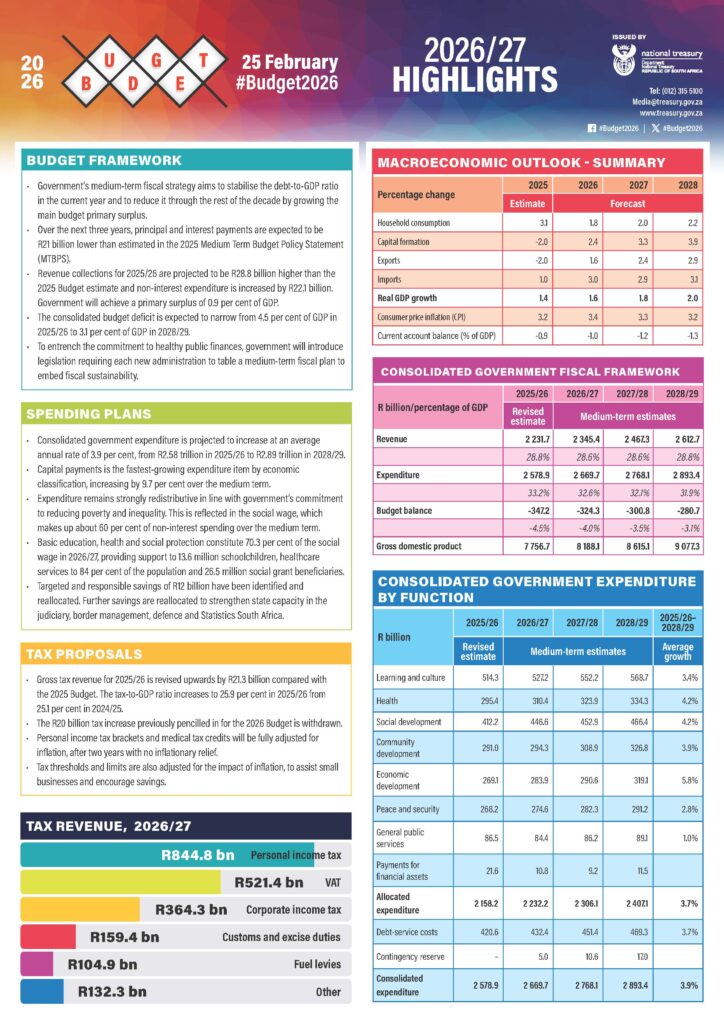
The Budget Speech emphasises that government’s tough decisions, spending control, consolidation and a disciplined fiscal posture, are beginning to deliver results. Treasury notes that debt levels are expected to peak this fiscal year and begin declining, marking a long‑awaited milestone in the pursuit of sustainability.
For the first time in more than a decade, Treasury believes the country is regaining fiscal stability, a meaningful sentiment, and certainly not one expressed lightly.
- Lower debt‑service costs free up space for growth
One of the most encouraging developments is the projected decline in debt‑service costs as a share of revenue. Treasury’s People’s Guide highlights that lower borrowing costs, combined with an improved inflation outlook, are expected to boost private investment and job creation.
This matters enormously: debt‑service costs have long operated as a silent tax on growth. Any relief here benefits the entire economy.
- Four consecutive quarters of economic growth
Treasury highlights four straight quarters of positive GDP growth, signalling a notable shift after years of stagnation. Improved energy availability, more reliable logistics, improved revenue collection from gold and platinum producers and better public finance management all support this trend.
The message is clear: the foundations are slowly strengthening and the momentum is forward.
Policy Measures Supporting Treasury’s Positive Stance
Tax relief that reaches households
After two years of bracket freezes, personal income tax brackets, rebates and thresholds have finally been fully adjusted for inflation, a welcome move that eliminates the stealth tax of bracket creep.
Critically, the R20 billion in planned tax increases has been withdrawn, thanks to stronger‑than‑expected tax collections. This provides meaningful breathing room for households.
Investment and Saving Incentives Have Been Materially Enhanced
The 2026 Budget delivers one of the strongest boosts to household investment capacity in recent memory. Multiple tax‑efficient saving mechanisms have been expanded, signalling government’s intention to promote long‑term saving, improved retirement readiness, and broader household financial resilience.
- Retirement Fund Contribution Limits Increased Significantly
The annual cap on tax‑deductible retirement fund contributions has been lifted from R350,000 to R430,000, while the 27.5% of taxable income rule remains unchanged.
High‑income earners now have an extra R80,000 of tax‑sheltered retirement space each year.
This allows for greater opportunities for taxpayers to lower taxable income while accelerating retirement asset growth.
- Tax Free Investment (TFI) Annual Limit Increased
The annual contribution allowance rises from R36 000 to R46 000, now permitting R3 833 per month (up from R3 000).
The lifetime limit unfortunately remains R500 000, but the higher annual limit allows investors to reach the R500 000 more quickly. This increases TFIs’ effectiveness as long‑term, compounding wealth‑building vehicles. We would have like to have seen this limit being lifted at the same time.
- Capital Gains Tax (CGT) Relief Expanded
Several CGT exclusions have been increased to soften the tax impact of sales of investments and portfolio adjustments, property disposals, and estate planning:
- Annual CGT exclusion: R40,000 → R50,000
- CGT exclusion in the year of death: R300,000 → R440,000
- Primary residence exclusion: R2 million → R3 million
These measures reduce friction for households managing assets, taking some profit or transitioning wealth. This is the first time the Annual CGT exclusion amount has been increased since 2017. We believe that this should be adjusted annually.
- Donations Tax Exemption Increased
The annual donations tax exemption rises from R100,000 to R150,000, enhancing flexibility for philanthropy, family support, or intergenerational planning.
SMEs Receive Meaningful Compliance Relief
The compulsory VAT registration threshold increases from R1 million to R2.3 million, sharply reducing administrative burdens for smaller businesses. Industry response confirms this is not a symbolic gesture, it is real operational relief that frees SMEs to reinvest rather than comply. We believe this is a good thing and way over time.
Offshore Flexibility Is Significantly Expanded
The Single Discretionary Allowance (SDA) doubles from R1 million to R2 million, greatly expanding offshore diversification opportunities without requiring a tax clearance PIN. This is a major enhancement for global asset allocation strategies.
Our Interpretation: Encouraging Signals… But Not a Clean Bill of Fiscal Health
Even with Treasury’s confident messaging, several cautionary markers remain.
- Debt stabilisation is a projection — not yet a trend
Treasury’s expectation of declining debt depends heavily on:
- consistent reform execution,
- sustained revenue performance,
- disciplined cost containment (including limiting corruption).
Any slippage in these areas, or slower‑than‑expected growth, could derail progress.
- Growth remains too low to solve structural problems
By Treasury’s own forecast, they expect medium‑term GDP growth in the 1.6%–2.0% range.
This is an improvement, but still far below the 5–6% sustained growth economists estimate is required to make a difference and meaningfully reduce unemployment or significantly expand the tax base. They need to look at getting rid of policies that are restricting growth.
- Fiscal credibility has improved, but remains fragile
Markets have responded positively to South Africa’s reform progress, including the successful exit from the FATF grey list and a credit rating upgrade.
However, credibility can be lost far quicker than it is gained.
- Structural risks persist: energy, logistics, and municipal governance
Although improvements are noted, these constraints have not yet disappeared. Treasury itself acknowledges that weak municipal performance and SOE inefficiencies continue to weigh heavily on South Africa’s growth potential.
Final View: A Better Budget — But One That Needs Careful Follow‑Through
From a personal‑finance and investment perspective, this is one of the most supportive Budgets in several years. Tax relief is meaningful, savings incentives are stronger, SMEs enjoy reduced compliance pressure, and offshore allowances open new diversification possibilities.
Treasury’s stance is understandably optimistic: projected debt stabilisation, lower interest‑cost pressure, and improved revenue performance give policymakers their strongest platform in years.
But optimism must be accompanied by vigilance. South Africa is not yet in the clear. Growth must accelerate, structural reforms must deepen, and fiscal discipline cannot slip.
So yes — this is a positive Budget, and one we welcome.
But its long‑term success will depend not on the announcements made, but on the execution that follows.

Recent Comments