
THE SILENT EROSION OF PURCHASING POWER AND YOUR WEALTH
In a recent Magwitch staff meeting, we were discussing inflation and one of the team mentioned how ridiculously expensive cheese has become.
Since then, I have found myself checking the price of a simple block of cheddar every time I walk through the dairy aisle. The conclusion is always the same: prices rarely stand still.
Most of us notice inflation through everyday purchases. We see it at the fuel pump, at restaurants, when paying school fees, or when doing our weekly grocery shopping. While these price increases can sometimes feel dramatic, they also highlight an important reality – inflation is constantly eroding the purchasing power of our money.
In this month’s Financial View, we look at just how powerful that erosion can be.
The concept of inflation is straightforward. It measures the rate at which the general price level of goods and services increases over time. As prices rise, each Rand buys a little less than it did before.
What makes inflation particularly dangerous is not a single year of rising prices, but the cumulative impact over decades.
To illustrate this, we analysed South African Consumer Price Index (CPI) data dating back to its inception in 1957. CPI measures changes in the cost of a representative basket of goods and services and has become the standard yardstick for measuring inflation. Although the basket has been updated many times to reflect changes in how South Africans live and spend, the CPI provides the longest consistent record of how prices have changed over time. Looking back to 1957 gives us almost 70 years of inflation data and allows us to see just how dramatically the purchasing power of the Rand has evolved across generations.
The results are astonishing.
A basket of goods that could be purchased for R100 in 1957 would require approximately R13,280 today to buy the same goods and services. In other words, prices have increased more than 130-fold over the past seven decades.
The reverse perspective is even more revealing.
If we convert today’s money into 1957 purchasing power, R100 today has roughly the same buying power as 75 cents had in 1957. In practical terms, more than 99% of the Rand’s purchasing power has disappeared over this period.
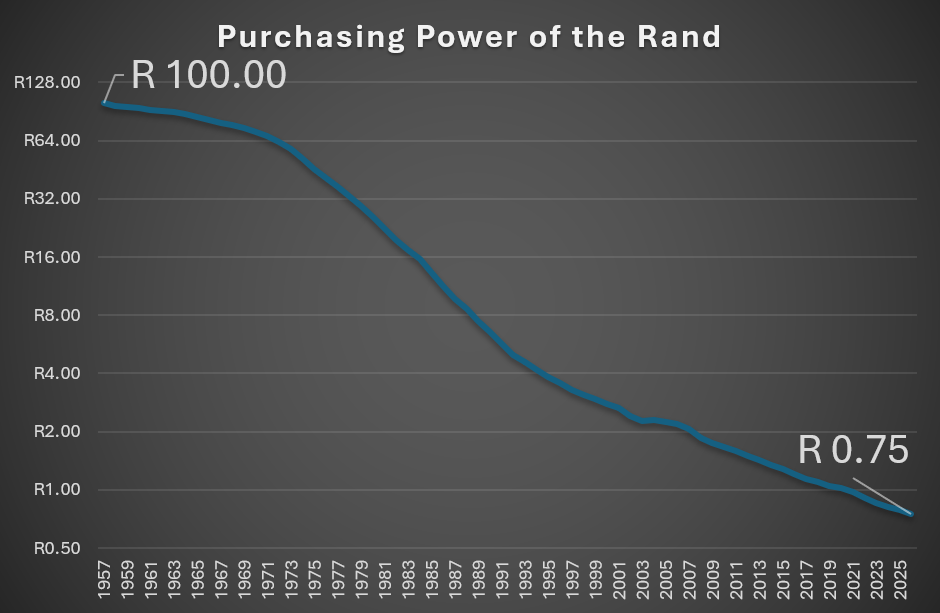
The decline is so dramatic that the chart requires a logarithmic scale simply to make the long-term trend visible.
This is why investors should focus not only on growing wealth, but on keeping up with or outperforming inflation and maintaining and increasing purchasing power. Ultimately, successful investing is not measured by the size of a portfolio, but by what that portfolio can buy in the future.
Imagine an investment that delivers a return of 5% per year. On the surface that may appear satisfactory. However, if inflation is running at 6%, your wealth is actually going backwards and losing ground in real terms. Your account balance may be growing, but the amount of goods and services that balance can purchase is shrinking.
The distinction between nominal returns and real returns is critical. Nominal returns tell us how much money we have made. Real returns tell us that we are outperforming inflation and whether our purchasing power has improved.
Over short periods inflation often feels manageable. A few percentage points in a single year do not appear particularly threatening. Yet inflation compounds in exactly the same way investment returns do. Just as compound investment growth can create wealth, compound inflation steadily destroys purchasing power.
For long-term investors, this presents a significant challenge.
Many financial goals extend over decades. Retirement planning, for example, often requires investment horizons of 20, 30 or even 40 years. Over these periods, inflation can become one of the greatest risks to your financial security. The retirement income that appears generous today may provide a very different lifestyle several decades from now.
This reality helps explain why growth assets such as equities play such an important role in long-term portfolios. While shares can experience significant short-term volatility, they have historically been among the most effective asset classes that generate returns above inflation over an extended period of time. Cash may feel safe because its value appears stable, but over long periods inflation quietly chips away at its spending power, this is especially so if taxes are deducted from the income.
The lesson is not that inflation should be feared. Rather, it should be recognised as an unavoidable part of investing and financial planning.
The simple cheddar cheese example that sparked our office discussion is really just a visible reminder of a much larger economic force at work. Inflation affects every aspect of our financial lives. It influences the cost of groceries, housing, education, healthcare and retirement.
More importantly, it influences the amount of investment growth or the return on investment we need to achieve to reach our goals.
The next time you notice the price of a household staple climbing, remember that you are seeing inflation in action. It may seem insignificant in the moment, but over time its impact can be extraordinary.
As the data since 1957 demonstrates, the real challenge for investors is not simply growing money. It is ensuring that our money continues to buy what we need it to buy in the future.
Because when it comes to long-term wealth creation, purchasing power is what really matters. It’s not only saving to retirement – but also once in retirement. You need sufficient exposure to growth assets to make sure you earn a real return to keep ahead of rising prices and inflation. Finally, you must never forget income tax, you must always make sure you returns are earned as efficiently for tax purposes as possible, because taxes can affect / reduce your after tax return.
Recent Comments